By Danny K. Crownover
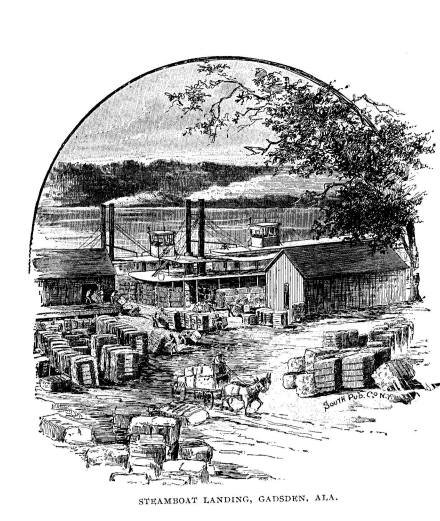
Legend has it that the wild reception of the first steamboat on the Coosa River when it reached Gadsden on July Fourth, 1845, was duplicated at Rome, Ga., and all along the stream, in fact, although there were few people in this part of the country at that time.
Captain James Lafferty, who brought the “Coosa” here and negotiated with the early settlers for making a landing place at the foot of Broad Street, continued on to Rome in due time.
Word had reached that place, which was nothing but a trading post at the time, that a strange craft with smoke boiling out of a tall stack and with a deep-throated whistle was picking its way over shoals and an uncharted channel to Georgia.
About 100 woodsmen gathered on a bluff to watch for the boat.
One of the men, Bill Bogan of Cedar Bluff, climbed up on a hill and, being the only “educated” man in the lot, he read the letters on the pilot house which were U.S.M. Coosa.
They meant that the boat would carry the United States mail and that its name was “Coosa,” but Bogan pronounced it “Use Em Susy” and that’s what it was called by many of the old timers for years to come.
However, Bogan’s companions called it the “Varmint” and it was also known by that name for a long time.
Captain Lafferty had no channel markings and no knowledge of the river from Greensport, 20 miles below Gadsden, to a distance of about 156 miles’ He was an experienced riverman, having brought his little craft down the Mississippi from Cincinnati, where it was built, to New Orleans and thence built to New Orleans and thence to Mobile.
He then sailed it up the Alabama to Wetumpka where it was knocked down and transported overland by ox teams to Greensport, where it was put together again.
On arriving at Gadsden, he struck a sharp bargain with the boosters of this place which was being considered as a town site, but had not been named. He landed what was known as Walker’s ferry which was at the point where Coosa Street now runs to the river.
The boosters wanted the landing at what is now Broad Street and they offered to give him one third of the 221 lots proposed for a town site to make his official landing at the latter place, also to name the new town Lafferty, but he declined that honor.
Legend also has it that the steamboat Coosa had much to do with developing this section because it provided transportation and encouraged farming.
Col. William Smith, one of the founders of Rome, built the first steamboat at that place. but it was never operated. He had been to the legislature and tried his best to get the legislature to make Rome a terminus for the state railroad. He was led to believe that he had succeeded in that project and built a boat named William Smith. It was launched without the machinery being aboard.
Just as he was about to put the finishing touches on the craft he got news that the state railroad was going to Chattanooga and would leave Rome out in the cold. At about the same time the boat sank.
Some accused Col. Smith of boring holes in the bottom of the Smith and allowed it to go to the bottom of the Coosa, because of his disgust at losing the railroad.
He merely laughed when the subject was mentioned. The Smith was never floated and its hull stuck up above the surface of the water for many years.