By Danny Crownover
Prior to 1897, city hall was at the Hollingsworth Building, in a rented room over what became the present office of the Stringer Realty Company on Fourth and Broad Streets.
It was reached by a steep stairway and was really too small, yet the city’s business was performed there for many years. The little room was the scene of many political battles by the Tow factions that really controlled the area around here.
I early years Gadsden City Hall was in the second story of the building later occupied by the old Dan Cohen Shoe Store on Broad Street.
In April of 1897, it returned to its previous location in the second-story of the Hollingsworth Building. City Hall was in the latter building when Mayor R. A. Mitchell and the city council fell out.
The council voted to move to the Broad Street place and the major refused to go along. He continued to hold police court and to do business in the old place and the matter was carried to the state supreme court which decided in the council’s favor.
That was during the days when the mayor refused to recognize the chief of police elected by the council. In fact, as soon as the council elected a man for the chief’s place the mayor suspended him and appointed a man of his own choosing.
The council would meet on the sidewalks and retaliate. It was quite a while before the row quieted down. Strangely enough, the officials engaged in this peculiar political and factional fight were really good friends.
On July of 1899, the local newspaper started a campaign that finally resulted in the building a City Hall owned by the city, but it started rather modestly.
“Gadsden is large enough to own a city hall and have a paid fire department,” the paper said. “It would be a good business policy for the city to purchase a lot build a city hall, city jail, fire hall, etc., and thereby save money. It now costs the city $45 a month for rents, a total of $540 a year. The city could sell $5,000 worth of bonds at four per cent interest, erect the necessary buildings and save $340 a year.”
Eventually, it began the agitation for a city hall and jail. Prisoners were housed in the little wooden building in an alley adjoining the lot of the county jail on Chestnut Street and it was not safe. During the week before one African American prisoner burned their way to freedom.
The newspaper was calling for a city hall, declaring the people wanted it and that they also wanted a new jail that was safe and fit for human habitation.
That little calaboose in the alley was about as filthy as any place could be. Many were embarrassed over the fact that Anniston, Talladega, Huntsville and Rome had city halls and Gadsden’s officers were housed in small rented rooms and up-stairs rooms.
In May of 1904, it was proposed that the new city hall would be erected on Fifth Street on the property then occupied by Otto Agricola Tin Shop. Architect A. D. Simpson was making the plans. A jail and a fire hall were to be included.
In May, 1904, the people of Gadsden voted in favor of issuing $25,000 in bonds for the purpose of building a city hall by a majority of 146 to 78.
The city, then purchased two lots on north fifth street for the city hall site. It also bought one that fronted on locust street.
It was early in December, 1904, that the city sold bonds to the amount of $25,000 for the purpose of building a city hall. The bonds were to draw interest at the rate of five per cent per annum and were to be due in 30 years.
A temporary building was put up on the Locust Street lot to provide shelter for the fire wagon and horse and to take care of horses and mules used by the street department.
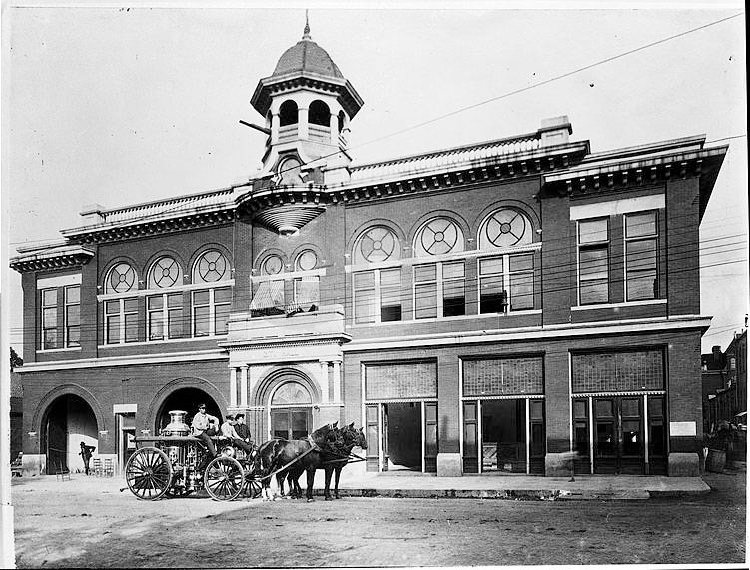
The plans, as made by architect A. D. Simpson, called for an auditorium or courtroom, a market, stables, a prison and a fire station. It was found necessary and very advisable later to build the prison separate from the main structure
After the new city hall was built, a brick building was erected to replace the temporary one housing the department.
Soon after, Robert Campbell, was nominated for mayor. He was a native of Scotland. It was during his administration that the old city hall was built.