By Caylie Moore, Features Editor
Dr. David Williams is no small man.
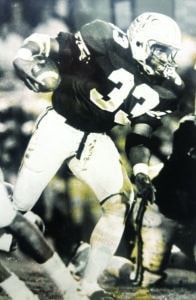
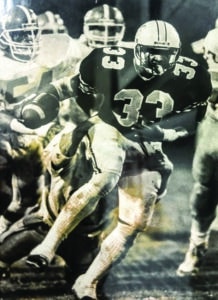
As a former collegiate running back, Williams stood exactly 6 feet tall and weighed nearly 220 pounds in the prime of his life, and he still towers over the average person when he walks into a room — though he works as an assistant principal at Oxford High School these days.
Still, his physique, born of lifelong athletic training under the hawkeyed guidance of his father, only tells one side of his multifaceted story. Williams has played many roles in his life — from teacher to coach to journalist to mentor — and he has the empathetic temperament of a man wise beyond his years to show for it.
What makes Williams least small, however, is not his form, shape or build; it is his willingness to share his vulnerabilities, fears and flaws with the world.
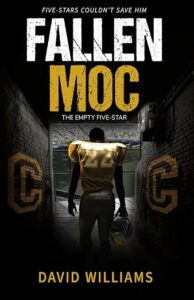
Williams’s new book Fallen Moc: The Empty Five-Star explores all of those things and more, functioning as a multi-part football-centered memoir that digs deep into what it means to be a young prodigy — and what it means to be a young prodigy who returns home with nothing, not even a sense of purpose.
“You can have a gift or talent or trait or whatever it may be — but not really have that attached to a purpose,” Williams stated in a sit-down interview with Gadsden Messenger. “Without that, it can be as detrimental as it can be uplifting. No one ever really talks about that.”
For Williams, not having a purpose attached to his football career made him, in short words, arrogant, and he wanted to dissect that arrogance through Fallen Moc.
“I realize in retrospect that I was pretty stuck-up, or something like that, because I thought I was God’s gift to football — instead of realizing that it was God’s gift to me. That was messed up,” Williams stated in a moment of honest reflection.
“All of [God’s gift] was taken away [from me], and then I had to earn it all back. When I was a star, I took it for granted,” Williams said, adding that he would find out other players were walk-ons and wonder why they were being paid to be a part of the team. “I didn’t understand their dreams, their goals, their desires or their love for the game.”
“When I walked away — so many times — and I had to earn back what I took for granted, it gave me an appreciation [for what I had lost], or a different lens on it.”
Williams summed up that learned appreciation concisely: “Hitting the bottom isn’t a bad thing if you’re able to rebuild in the right way. That can really be — at least for me — a blessing. I needed that.”
Williams also emphasized that anyone could learn from the lessons featured in his memoir. “I think so much of [our lived experience] is individualized, but it’s also universal. Because everyone has their ups and downs; everyone has their struggles; everyone has that gift or that talent.”
Because of those many life lessons — some short and sweet, others long and cruel — Williams has been able to use his story to relate to people of all ages, including his own high school students.
“To see the cumulative impact of all those life lessons and being able to share that with the various students that I interact with at different stages of their lives… Now it all becomes wisdom, and I can say, ‘Hey, you’re an 11th grader now, but pretty soon you’re going to be outside of [the school] doors, and if you don’t learn to conquer these things, it’s going to limit your potential.’”
Williams highlighted one such case while discussing his own struggles bringing his memoir together. “I started writing this book many, many years ago, but I was never able to finish it because of my own immaturity. Later on in the book, when I am going through certain hardships, I think to myself, ‘Why are they doing this to me?’ But a lot of those [hardships] I played a role in.”
Still, even when Williams was excelling outwardly and succeeding objectively, he had a hard time coping with the fact that he did not know what his purpose in life was.
“My parents told me that if I made good grades and I did good in sports, I’d be happy. Well, I suddenly realized — I’m not happy,” Williams stated, adding that while he was a “big man” on campus during the day, he was only sad and unfulfilled at night, with no one and nothing to turn to either.
“And if I’m not happy with this level of success, how will more success at the next level make me happy?”
Once Williams had that realization, it was hard to keep up any passion for football, and he left the team soon after, marking just one of many times that he left the sport — a decision that confused the people that knew him but made perfect sense to him at the time.
But that did not stop people from trying to understand the why anyway, even though Williams refused to talk about it.
“When you leave home a hero, there’s an expectation — ‘He’s going to conquer the world.’ You’ve been telling everyone that you’re going pro, and you’ve been doing pro-like things. Then you come back, and you’re still 6 feet tall, 200-something pounds, but you’re just walking around! You don’t want to talk about football. You don’t want to explain the unexplainable.”
Although Williams was going through something “unexplainable” to most people, there were still people in his life who wanted to help him and put him on the right track.
“There was one lady — her name was Dale Hill — and she was a mentor at Gadsden State. She saw me walking through the campus one day, and she said, ‘David, come to my office.’ Because she had been someone who had mentored me throughout my teenage years, I gave her space; she had earned the right to say something.”
“I went to her office, and she sat me down and said, ‘You need to be playing football.’ I reasoned in that moment that maybe that’s what people do — maybe they do what they’re good at, even though they’re not happy or content,” Williams stated, explaining that he never asked his own parents whether they were happy working at Goodyear or in the military. “Maybe that’s what maturity is.”
Hill contacted the NCAA for Williams, who told him that he would have to graduate from Gadsden State in order to rejoin the football league. Although he was still somewhat apprehensive about returning, it put him on a path that has stayed with him throughout the rest of his life. “I was studying very late academically so that I could graduate [from Gadsden State and rejoin college football], and I was studying the playbook so that I could make a good enough impression to hopefully make the team. That’s how the third return started.”
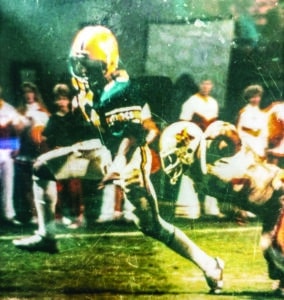
Williams’s gratitude towards the people who have helped him along the way cannot be understated; a somber reminder of that gratitude also pushed him to start writing his memoir again.
“On the day that I got my doctorate, I looked back on the school website, and the coach that had signed me to my scholarship had passed. I got to reflecting that had it not been for the scholarship and the potential he saw in me, I never would have been on this path. I really appreciated that — even though the way it all transpired was never how I envisioned it. It made me a better me in the end, and that’s when I started back writing the book in earnest and appreciating the conduits that God used to shape me.”
Still, while Williams eventually went on to play for the University of Tennessee at Chattanooga, it was not an easy road. In fact, it was a road filled to the brim with hardships, ones where he felt isolated, including an instance where he was kicked off the team, moved from his apartment into one of the worst dorms on campus and made into a social pariah to his teammates.
As such, he was not always so grateful for where he had come from in the moment, and it was not until a godly intervention took place that he was able to reflect on his life in a different way.
“[After that incident] I told myself, ‘You can take my scholarship; you can kick me from my apartment; but you can’t not make me an athlete.’ So I got on my bicycle and rode for about 24 to 28 miles, and when my uncle got there later, he asked me, ‘David, do you want to go to church with me?’ Normally, it would have been a no, because growing up in a military family, we didn’t go to church much, and I just didn’t know much about God. But I had failed at everything, and I’m thinking, ‘Yeah, I’ll go.’”
Williams noted that what happened next was a “turning point.” “Normally, if I’m in a setting where I don’t know anything, I’m going to be as quiet as a mouse. I didn’t know anything about the Bible or God. But my uncle introduced me to the guys there, and we shook hands — then they asked if anyone needed prayers. My mom had been having problems with her back from Goodyear,” he said. And so — despite his quiet nature when it came to things he did not know — he asked them to pray for her.
For Williams, that already indicated that that day would be unusual — something special.
“The preacher starts reading the Bible aloud, going, “The Bible says, ‘If any man be in Christ, he’s a new creature. Old things are passed away; all things are made new.’ And I promise you, when he said that, it felt like a furnace lit inside of me. I raised my hand — here I’m speaking for the second time in a setting where I’d normally say nothing — and I asked him to read it again.” He did, and Williams asked him if he was telling the truth, to which the preacher replied yes.
“I said, ‘You’re telling me God will let me start over?’ And he said yes. I knew I needed to start over — I’d messed up, and at that point, I felt like I’d disappointed everybody, including myself, and I couldn’t figure out how to do any of the things I used to take for granted. The rest of the Bible study was a blur really — but that stuck.”
Williams’s uncle dropped him off back at his isolating dorm room afterwards, and as soon as Williams got back inside, he got on his knees and prayed.
“I said, ‘God, if you’re real, save me. I have done all that I’ve wanted to do, and I’ve messed up everything. I’ll live for you. Let your Son come into my life and save me.’ Somewhere along that way, the tears went from sadness to joy — and when I got up, that was it.”
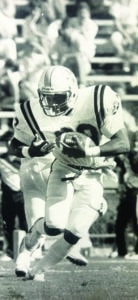
Williams returned to football yet again after this, but he said that this fourth return was notably different. “Now I wasn’t running to go pro. I made the Dean’s List and started doing good academically. I had my priorities in order.”
While he still faced trials — such as when he returned as a junior and was forced to switch from leading rusher to fullback — he treated those as tests of whether he was going to quit when the going got tough. Instead of falling into his usual habits and leaving his team, Williams stopped and reasoned with himself that he would take the new position and use it as an opportunity to show the NFL teams that he could not only run the ball but also block.
After enduring the change as a junior, Williams would return to his previous position in his senior year, and he was awarded the MVP title that year. If his junior year was a test, his senior year was the reward for passing it — and it showed that things were always hard before they became easy.
“God can take whatever situation and make a person victorious,” Williams concluded thoughtfully. “God can take a broken, hurt, misguided person whose life is full of mistakes — and make something of that individual.”
When asked for any final thoughts he wanted to share, Williams simply replied, “The book says it all.”
Readers can find Fallen Moc: The Empty Five-Star on Amazon today. A sequel to his memoir — titled Risen Moc: After the Fall — is also in the works. Dr. David Williams, who would also like to begin giving talks again and hopes his memoir will allow him to do just that, can be contacted at [email protected].