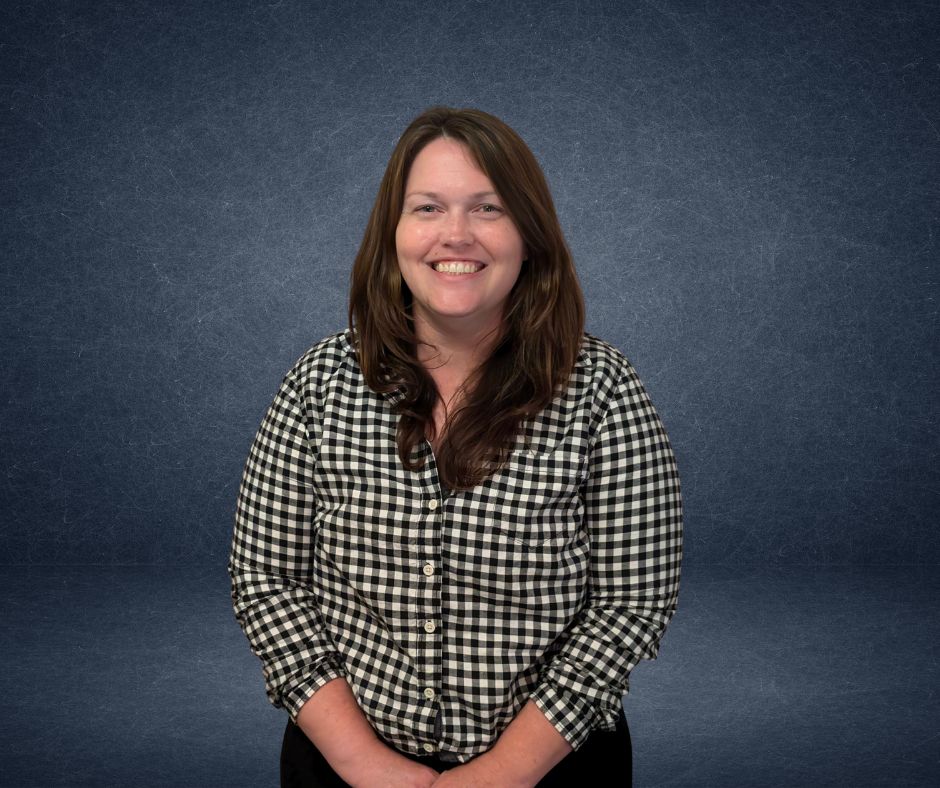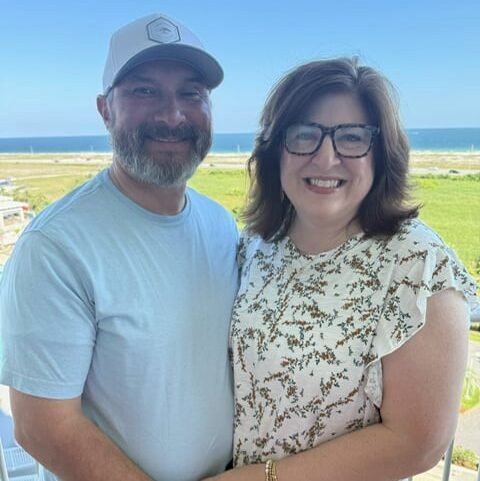
Photo submitted by Betsy Gulledge.
By Lindsey Frazier, Features Editor
Editors Note: During National Kidney Awareness Month, the Messenger has sat down with two members of our community who have been dealing with more than a decade of kidney failure between the both of them.
For our last article, we spoke with Joel Gulledge, the principal at Gadsden City High School who is living with a different kidney disease – kidney cancer.
Each interview provided a deeper understanding of the realities of living with kidney disease. However, a constant thread was the importance of paying attention to your body, knowing the risk factors and seeking medical attention as soon as possible.
Layers of photos lined the shelf in his office — images of him and his family laughing and smiling, looking down on him from above.
In 2018, just before his oldest daughter’s wedding, Joel Gulledge went to the doctor expecting kidney stones. He had experienced them before and wanted to make sure one wouldn’t move during the ceremony, he said.
“It was just kind of an uncomfortable feeling,” said Gulledge, principal at Gadsden City High School. “Honestly, if it wouldn’t have been for my daughter getting married, I probably wouldn’t have gone and gotten checked.”
The Monday after Father’s Day, Gulledge was told he had a 10-centimeter mass on his kidney. His doctor had known about the spot the Friday before but chose not to tell him so he could enjoy the holiday with his family.
Because of the tumor’s size, doctors believed it was cancerous and decided to remove the entire kidney. The diagnosis was confirmed after surgery in July 2018.
His first call after hearing the news was to his wife, Betsy Di Benedetto Gulledge. The only time his voice wavered during the interview was when he talked about how much she meant to him.
Betsy Gulledge serves as chief nursing administrator and associate dean for the College of Health Professionals and Wellness and School of Nursing.
“You know, in her job field, I’m sure she knows a lot more than she tells me, and that’s fine,” Gulledge said. “She tells me what I need to know and answers my questions when I have them. I can’t stress enough how much she’s meant to me and how much I love her.”
At the time, Gulledge was principal at Gadsden Middle School, where he said the Gadsden City system was “absolutely tremendous” during his recovery. From the faculty and staff to the superintendent, he said everyone worked together to make life easier for him.
Gadsden City continues to do the same for him at the high school, he said.
“My wife, two daughters and my son-in-laws have been great,” Gulledge said. “I couldn’t have asked for a better support system from my work family to my real family.”
Now, every other Monday, Gulledge spends 45 minutes to an hour at the Gadsden Cancer Clinic at Hematology and Oncology Associates of Alabama before heading to school for the day. There, he undergoes immunotherapy, a treatment that uses the body’s own defenses to fight cancer.
According to the American Cancer Society, immunotherapy boosts the immune system and uses lab-made substances to help the body identify and attack cancer cells.
In January 2024, Gulledge began with double immunotherapy to combat some small spots that were there in 2018 but had grown some since then. That only lasted until March when he dropped down to a single treatment.
“You have to stay positive,” Gulledge said. “You can allow it to take you to a dark place, especially if you start Googling things. I would recommend you do not look things up, because you’re going to see the worst of the worst.”
Gulledge remains under the care of Dr. Elquis Castillo, founder of the cancer center, along with a team that includes a pulmonologist, hematologist, urologist and general practitioner—all based locally, to monitor his progress and potential recurrences.
“I think too often people think that when you get a diagnosis like this, your immediate thought is, ‘I need to go to Birmingham or I need to go to Houston,’” Gulledge said. “But people need to know that we have great doctors and nurses and practices here in town.”
A small spot was found on his kidney not long ago, but doctors were able to treat it with ablation therapy, where doctors kill cancer cells with either very hot or very cold temperature, according to the MD Anderson Cancer Center.
He said his doctors collaborate closely to determine the best course of treatment. Gulledge said he doesn’t see an end in sight for his treatments, but with the wonderful care he receives from Dr. Castillo, nurse practitioner, the nurses and all the staff at GCC, he’s fine with it from now on.
“We’ve been through this, my girls as well, but as long as she and I remain confident in what we’re doing, we do what we are asked to do.” Gulledge said.
According to the American Cancer Society, more than 80,000 people in the United States are expected to be diagnosed with kidney and renal pelvis cancers in 2026. While rates have increased over time, improved technology has also made detection more common.