By Danny Crownover
In today’s timekeeping, clocks have been made so accurate that they are able to keep time through atomic clocks to the micro-second. However, little known is the fact that Gadsden had a clock in the 1870s that was almost as accurate.

Sam May, who conducts a jewelry store at 518 Broad Street, had one of the oldest clocks in Gadsden that was also one of the most accurate timekeepers to be found anywhere.
It was of the grandfather type and around six feet in height. It was encased in highly polished oak and was really a very beautiful machine.
So far as can be ascertained in the 1950s, it had been running for almost 80 years and varied as much as a second. The motive power is a heavy weight, just as all old-time clocks were operated.
It has a windlass wing in the face with a long metal pendulum suspended from a point above the works.
At the bottom end of the pendulum are three glass jars filled with mercury, thus affording a counterbalance in respect to expansion and contraction such as to provide perfect compensation.
In other words, the swing of the pendulum is the same in all kinds of temperature. Each year May takes it apart, cleans and oils the parts and makes repairs that might be necessary.
Seldom repairs were needed. It manufactured by Waterbury, one of the oldest clock and watch makers in the country.
The clock hung on the wall near the front door and many citizens daily set their watches by it. May receives time signals from Washington and never found the old timepiece to vary more than a second.
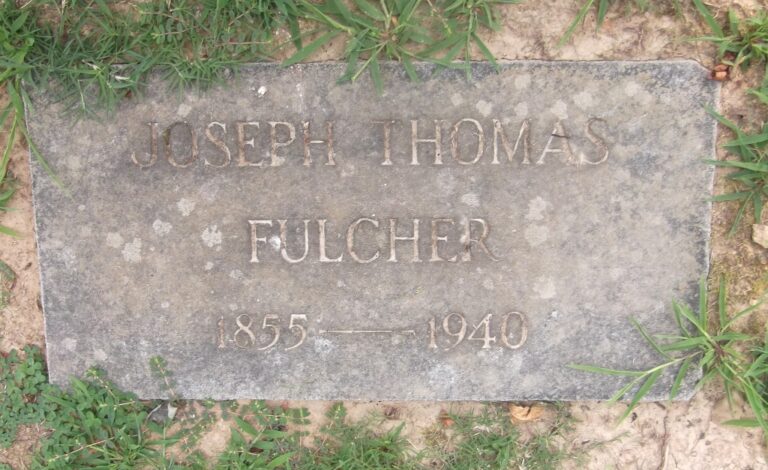
The clock was owned by most of the old jewelers of Gadsden. May bought it from a jeweler who went out of business in 1924. He traced it back to the original owner who was Joet Fulcher, who was a jeweler and watchmaker back in the 1870s.
It was remembered Fulcher occupied what was called the “Round Front” building on the south side of Broad Street in the 300 block. The building got its name from the fact that its false front was round instead of square, the prevailing style in the early days of the city.
He was next door to the Pat Walsh tin and store shop, a two-story structure a few doors removed from the Third Street corner.
Back in 1882, Fulcher was quite a young man but he was recognized as a mechanical genius by everybody. He was always inquiring about new mechanical devices and was tinkering with many of various sorts in his spare time to practice on his cornet during business hours, for he was a member of the Silver Cornet Band back in the 1870s and 1880s.
The great fire on July 4, 1883 destroyed his store and it is not recalled whether he even resumed his store. He probably did, as some years later he was watchmaker for the R.O. Randall jewelry store and while there he was called up to repair and readjust the old fashion carbon electric street lamps.
In making such repairs and adjustments he studied electricity and later became superintendent of the Queen City Electric Company which furnished electric lights and power for the city.
When the company had its power plant on the south side of Broad Street in the 200 block, not far from the present Merril Lynch building, he had found time to experiment with bicycles and flying machines. Fulcher later moved to Guntersville to build and manage an ice factory; an electric plant and water works.
Contact The Vagabond at [email protected].