By Danny Crownover [The Vagabond]
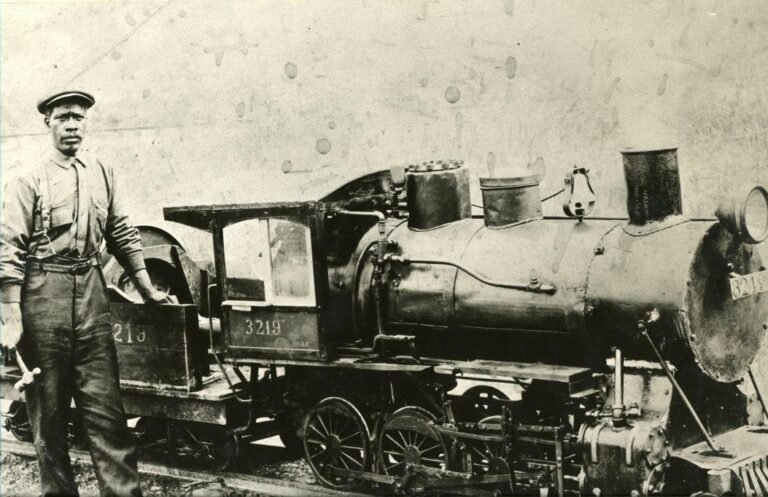
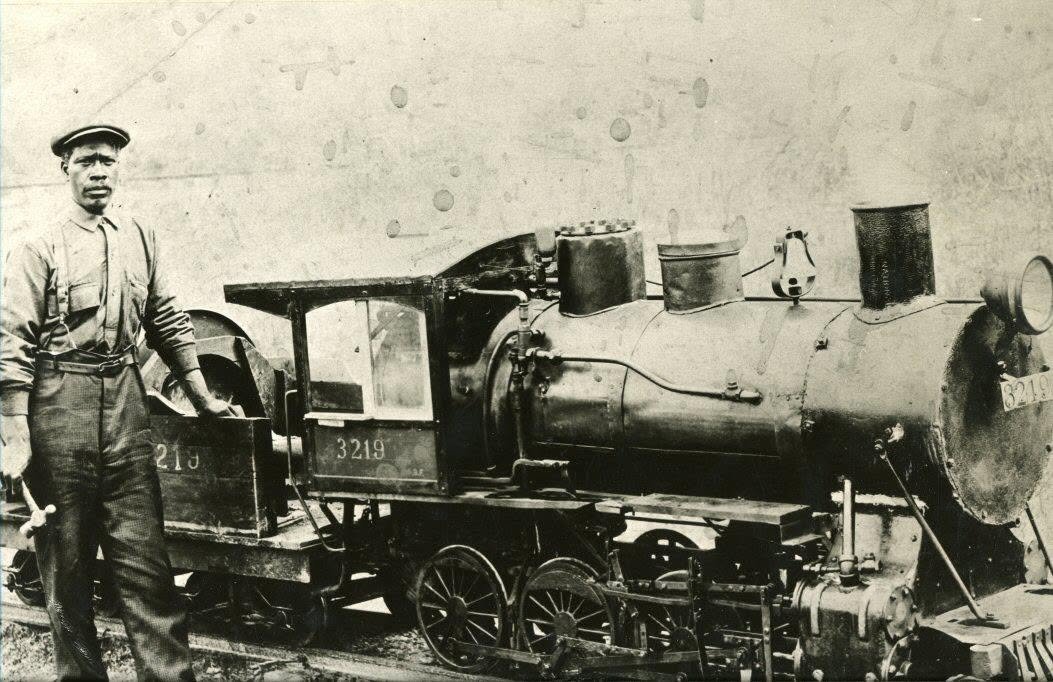
During the First World War, a photograph of a miniature locomotive circulated widely and attracted much local attention. Many mechanical engineers across the state regarded it as a remarkable achievement.
It was built by Jack Marshall, a 53-year-old African American laborer who worked at the blast furnaces of the Alabama Company, which were later taken over by the Sloss Company.
It was a perfect piece of machinery, every part of which functioned properly. The locomotive was modeled after the type used by the Chicago, Milwaukee & St. Paul Railroad.
Marshall built it entirely by hand with tools that cost him $14. He was a hot-pot repairer who worked regularly during the day and tinkered with his locomotive at night by the light of a cheap oil lamp.
He began the project in June 1913 by making a rough drawing. He reduced the drawing to scale and then created a blueprint. Through infinite patience and remarkable industry, this humble laborer, working for four years in an old shanty of a home, produced an amazing model of a locomotive, one of the most remarkable to be found anywhere.
It was a beautiful machine, perfectly appointed and showing fine workmanship in every detail. The miniature engine was of the Mikado type. It had 10 drivers and a pony truck, quick-operating firebox doors and Walsh valve gear.
The track gauge was 6 3/4 inches. The driving wheels were 6 5/8 inches in diameter, and the stroke was 1 1/4 inches. The boiler head was 8 inches in diameter.
Every part of the locomotive was scaled down with astonishing mathematical accuracy. In every detail, it was built in absolutely correct proportion.
Its lines were as beautiful as those of the enormous machines produced at the great Baldwin locomotive works.
Marshall was a natural mechanic. His machine was made entirely of metal, and he fashioned most of the pieces by hand using a hammer, chisel and file.
That was the reason it took him four years to complete the project.
Originally, Marshall set out to build a miniature locomotive to test and demonstrate an automatic switch he was developing.
Marshall was considered a mechanical genius, yet he never had the opportunity for formal schooling. There was no telling what he might have accomplished with an education and proper training in mechanical engineering.