By Lindsey Frazier, Features Editor
June Scobee Rodgers grew up in Odenville in the “poorest family among poor neighbors”, being teased by the kids on the bus, with a dream to be a teacher.
Now, she meets with kings, presidents and movie stars as the founding chair of the Challenger Center, and the widow of the Challenger space shuttle Commander Richard Scobee.
“I keep thinking, you’re June from that little school where the kids teased you when you got on the school bus with mud all over your shoes,” Rodgers said.
As we talked, people kept walking up to Rodgers to tell her how inspired they are by her and what an “incredible” lady she is. Humbly, she took the compliments.
“I can’t believe my life,” Rodgers said. “I have been blessed, I should say more than I deserve, but it’s because I believe in God’s support and love.”
On Jan. 28, 1986, the Challenger exploded 73 seconds into its flight, killing the seven passengers, including Christa McAuliffe, the first teacher to fly in space, as it was broadcast to billions around the world.
The Teacher in Space program was created to honor educators and inspire students by sending a teacher as the first civilian in space. The intention was to have McAuliffe connect directly to students from space and teach lessons to increase interest in mathematics, science and space exploration.
“Every new Challenger Learning Center is a combination of our work to continue the Challenger mission,” Rodgers said with tear filled eyes. “The teacher, Christa McAuliffe, was a personal friend of mine.”
Rodgers married Scobee as a teenager in San Antonio where he was training as a military aircraft mechanic, she wanted to be a teacher and he wanted to be a pilot, each supported the other until they had fulfilled those dreams, she said. At the time of the accident, Rodgers was a professor at Texas A&M University where she created a space program. After the accident, she decided to expand the program into a mission.
She wanted to honor McAuliffe and crew, who all had educational experience or an educational project they were working on.
“So, I look back and think, did we accomplish what our vision was?” Rodgers said. “It just gets better with every new learning center.”
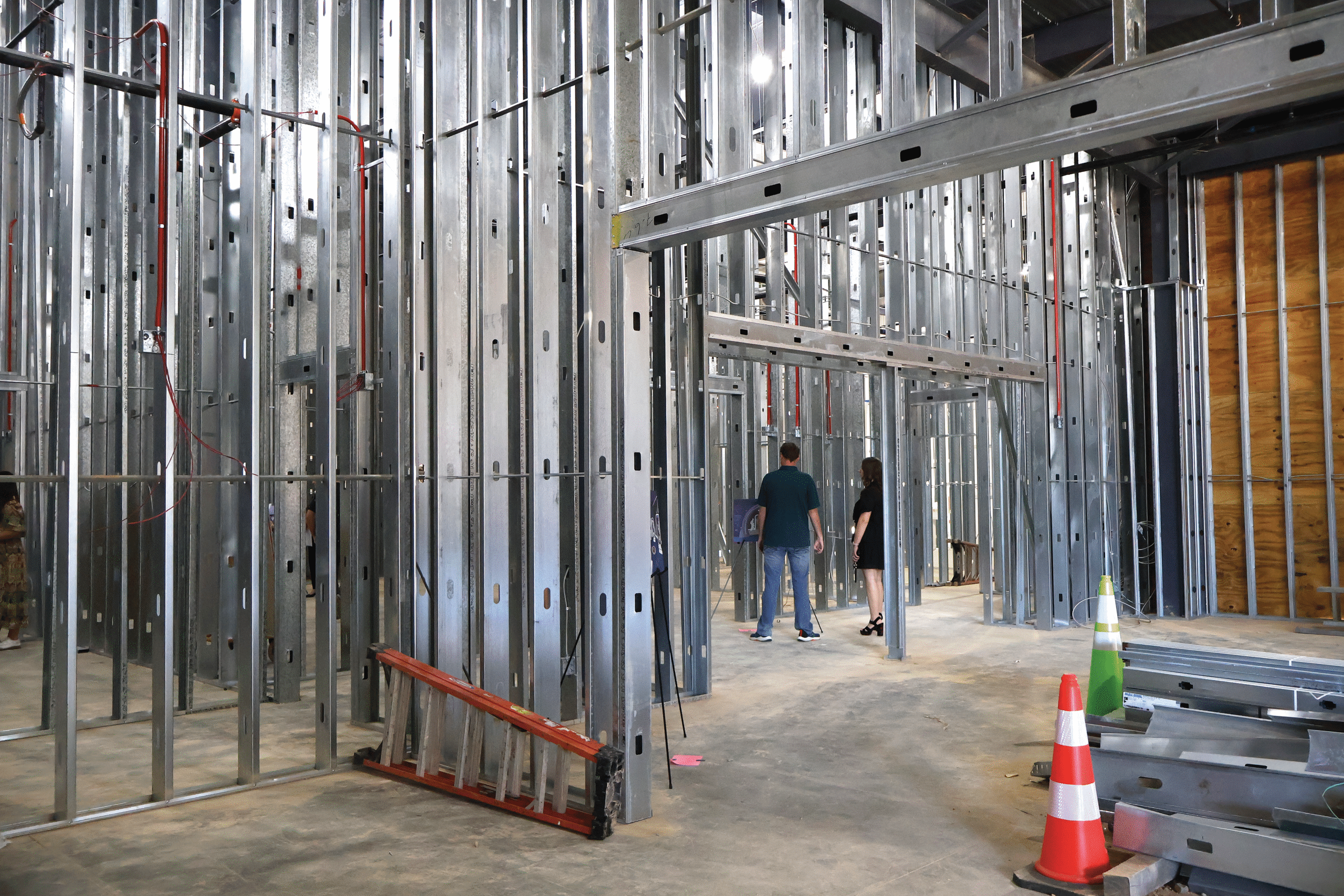
There are 34 challenger centers across the globe that work as a partnership between the national headquarters and local organizations. Some of which are only 5,000 square feet, but the one in Rainbow City will be 15,000. The Facility will employ four or five full-time employees and three to four part-time employees.
“The vision of your folks, your building folks that built the dream for your area, they were all brilliant with their heart in the right places,” Rodgers said. “I talked to the people… that are the fundraisers… That’s what it takes, believing you can do it. Believing in a power greater than yourself that will help you, and then committing, have the courage to make a commitment… and then the vision to see it through.”
The center will act as a challenger simulator focused on problem-solving skills, communication, technology and collaboration. It will be equipped with state-of-the-art learning resources, two STEM classrooms, exhibits and STEM immersion.
When students come to the center they will be divided into two groups, one team, mission control, will go to the classrooms and the other, spacecraft team, will proceed to the “briefing room”, before starting their mission in the spacecraft, a $2.4 million simulator funded by a federal appropriation from Rep. Robert Aderholt, according to Mark Condra, challenger center chairperson.
The teams will have to communicate through various stages of the mission, from decontamination to debriefing, then the teams will switch places and run the mission again, Condra said.
During the school year, the facility will host students from 12 surrounding counties in Northeast Alabama, who must provide transportation to the facility. There will also be opportunities for summer camps and private events.
Efforts are being made to raise around $3 million to provide scholarships so students can attend the facility for free, according to Condra. So far the facility has gained funding via grants and donations, but soon there will be opportunities for the public to purchase sponsorships and naming opportunities.
The goal is to have the center finished by the beginning of 2026.