By Tabitha Bozeman
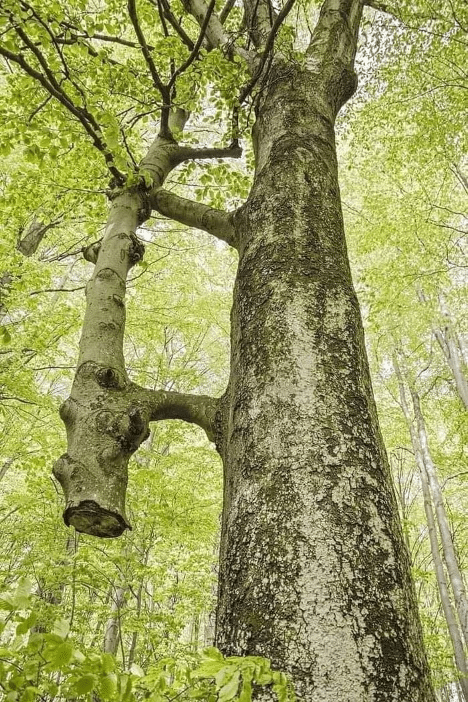
I came across a photo this week of two trees growing together. I have seen many trees twisted together or leaning against one another. What stood out in this picture was how one tree was completely missing its bottom half. No roots, no trunk, nothing in contact with the ground. It just hovered in the air, a partial trunk and leafy branches, held up by another tree beside it. At first it looked like a doctored photo, but as I read further it turned out that it was in fact an actual photo of two trees engaged in a process called inosculation. The internet helpfully defined this term for me as “the natural phenomenon where the trunks, branches, or roots of two or more trees grow together and fuse, similar to grafting.”
Intrigued, I looked into this some more. I knew that there were plants that depend on trees for support and nutrients in sometimes symbiotic, sometimes parasitic tradeoffs, and that this is often bad for the trees. In fact, our landscaper has repeatedly had to trim back and pull down English ivy, kudzu, and “blaspheme vines”. I know that the gorgeous wisteria I look forward to every spring isn’t necessarily good for the trees it attaches itself to. And, recently, I’ve seen articles about English ivy being banned in some areas. In nature and humanity alike, there are relationships that benefit one party, but harm another. This is nothing new. However, there are many give-and-take relationships that benefit all involved.
As children, we learn about plants and animals in very basic, black and white, good and bad, circle-of-life terms. Even beloved Disney cartoons we grew up singing along to teach us about the harsh realities of nature and life. There are predators, and there are prey. There are terrified gazelle and hungry lions. There are scared deer and determined hunters. There are wily snakes and oblivious little boys. The examples go on and on. These stories serve many purposes: they are engaging and capture our imaginations, and they scratch the itch our brains have for solid story structure. There are good guys, bad guys, suspense, loss, lessons learned, and a neat resolution. We need these stories to make sense of the unknown, and the uncomfortable in the midst of the sheer scariness of life. But what about the stories that don’t fit those molds? What about the apparent pointlessness of the altruistic tree holding up a neighbor and sustaining it just because it is there, someone chopped it off from its root system, and it would die without support?
I’ve written before about how trees can communicate with one another using networks of mycorrhizal, electrical signals, and fungi called the “wood-wide web,” but inosculation to the extent in the photo was new to me, and I think it really stood out because of the chapter we universally experienced that demanded many work altruistically, knowing they could experience negative effects. Many needed help but were unable to do anything about it without the care of others. During this time, our family also experienced coming together to care for my grandmother in her last years, and that was hard but also wonderful in unexpected ways. My sister and I grew closer, and my children helped take care of someone purely out of love, not expecting to receive anything in return. Often, it felt like our family and extended friend-family communicated much like the trees, intuiting needs, sending deliveries, and checking on one another. It was a rough chapter for, quite literally, the entire world, but there was an odd comfort in seeing how many people were willing to pull together, too.
I think this is why the tree captured my attention this week. There is so much division around us right now. More than I have ever experienced or witnessed in my life before. It is easy to dehumanize those with different ideas and beliefs and priorities. It is easy to live in a bubble of bias-confirmation and like-mindedness. It is easy to identify those we disagree with based on bumper stickers, tattoos, T-shirts, social media posts, and vehicle choices. It is easy to imagine that those cartoons we grow up with have it right in regards to predator vs. prey. It is much easier to see differences instead of similarities. But even the trees know when nothing else matters besides helping out a neighbor.
The definition of inosculation went on to explain the process: when two trees are in close proximity, they can injure one another, rubbing raw spots, exposing and damaging living tissue. Rather than drawing away, identifying the other as an enemy, the trees cover one another’s injuries, both healing by coming together. One tree might provide the root system for stability and nutrients, while another tree provides a robust leaf canopy. But they aren’t keeping tabs. They are offering what they have, supporting one another, healing and growing together.
How much more beautiful would our lives be if we emulated the trees a little more?