By Caylie Moore, Features Editor
Amy McCormick knows from firsthand experience just how strong the healing power of horses is — and she has made it her life goal to ensure that everyone else gets to experience it, too.
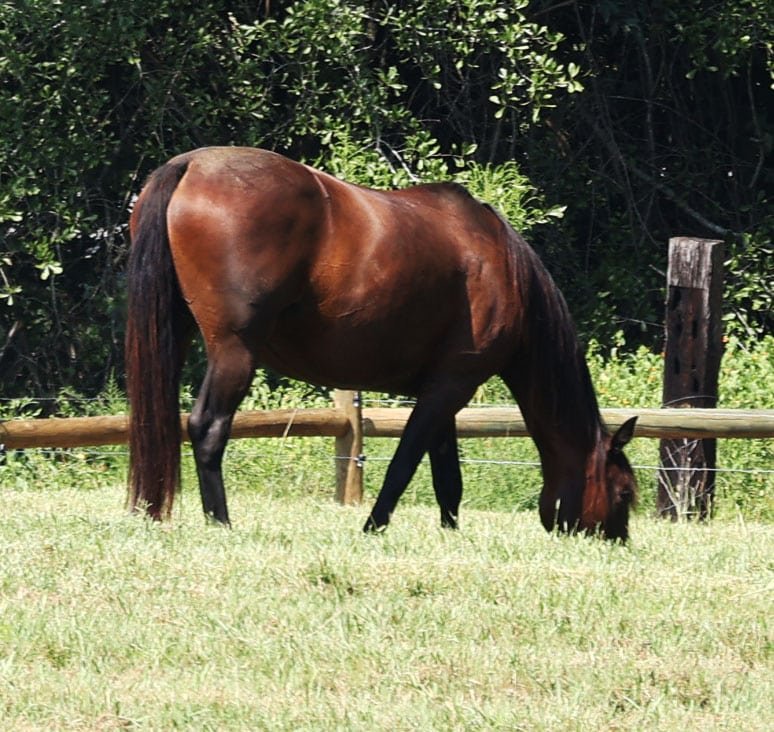
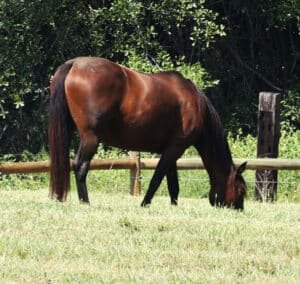
“My little girl Olive” — one of the many rescued horses on Anchor of Hope Ranch — “is in her 40s, and she’s gotten me through so many bad journeys and bad situations and bad seasons. She gives me purpose.”
And for McCormick, that purpose is clear: helping people build therapeutic relationships with horses — a more mutually beneficial relationship than most people might believe. “Horses just want to be seen — just like people,” McCormick stated in an interview with Messenger’s Features Editor Caylie Moore, who had the opportunity to visit the ranch and see firsthand what McCormick did at Hope in Her Eyes.
“We want to be seen, we want to be validated, we want to be heard. And they show up — no judgment, no passive-aggressive behaviors. What you bring today might not be what you bring tomorrow, but they’ll be there again for you tomorrow.”
As the owner of Hope in Her Eyes, a “faith-centered nonprofit dedicated to helping individuals find healing, resilience and renewed purpose through the powerful connection between humans and horses,” McCormick has spent the past few years of her life busy with all that a part-rancher-part-therapist must do before the day is over.
Certified as an EAGALA (Equine Assisted Growth and Learning Association) Military Equine Specialist in 2022, Hope in Her Eyes has been officially operating since 2019, and since January of 2020 as a nonprofit — though it has its oldest roots in New Jersey, where it found its start. Since its founding, the program has helped hundreds of people all across the East Coast.
“We’ve done retreats for kids in New York City where law enforcement would bring them down for barbecues, and we would let them know what it was like to be out on the ranch and have a horse ride…We’ve also done stuff with social workers in groups of 20 or 30, so they don’t have to pour from an empty cup because they already have to do the heavy lifting,” McCormick explained, adding that she has seen a variety of people come through the ranch’s gates for a variety of reasons. “In North Jersey, I was more focused on the mental health of veterans, but down here, the foster system and the kids — there’s countless more than I saw in North Jersey. So that’s where my heart’s really pulling me [right now].”
McCormick was more than happy to explain the thought processes — both scientific and personal — behind horse-facilitated therapy.
“There is nothing that lives more in the present than a horse. When we go through any kind of therapy, they tell us to practice mindfulness and not to get lost in our thoughts. Horses teach us that because we have to be very aware of them,” McCormick stated. “You walk in with a 1,200-pound animal, you have to be aware of where your feet are, and you have to be aware of where his tail is. They teach us a lot about just being present in our bodies.”
McCormick used this opportunity to go through the process of on-the-ground wellness sessions. “Once we start to get comfortable, the beauty of being on the ground is that [horses’] hearts are so much larger than humans’ and have an electromagnetic field that is five times larger than ours, so the energy that they pull from us, they use to mirror our heartbeat and help relax our nervous system…That’s where all of the good stuff happens, like reducing your cortisol levels — cortisol keeps us spiraling — and releasing serotonin — your feel-good hormone,” she explained. “That’s on-the-ground — just interacting, grooming and being in their presence.”
“It’s all research-based,” McCormick added, noting that EAGALA and Path Therapeutics, a biotechnology company that discovers new treatments for brain disorders, have both studied and contributed to the literature surrounding horse-facilitated therapy. “Research has said that they take about eight couch therapy sessions off the table when you bring a horse into the equation.”
Hope in Her Eye’s other service, Draper Sensory Therapy, is more specialized — but equally as effective. Conducted on horseback and using the “natural rhythmic movement of the horse to stimulate and regulate the brain and nervous system,” this brain-first approach incorporates unique techniques — like riding backwards — to activate sensory pathways and improve balance, coordination and neural connectivity. When performed across multiple sessions, Draper Sensory Therapy provides “effective, long-term healing” to those with neurological conditions like TBI and autism.
“What we do with the Draper Sensory Therapy, where you sit backwards, is create a state of homeostasis — how God made us, with no stress. When we do that, we take advantage of the brain’s ability to repair itself — the neuroplasticity of the brain. We try to re-engage the right and left hemispheres, getting that logic and reasoning part of our brain back in focus.”
Both types of horse-facilitated therapy, McCormick reassured, have significant scientific backing.
But beyond the science is an even more intimate reason as to why McCormick chose to pursue this line of work, as opposed to other, more traditional types of therapies.
“[The why] is my deep, personal place…My daughter was diagnosed with PTSD, severe depression and anxiety at 11 years old. Her first suicide attempt and suicidal ideations were [around then], and she had two suicide attempts thereafter, three in total. There’s no doubt in my mind that Hope — who all of this is named after, our first rescue — saved her life countless times. [Hope] gave [my daughter] purpose, she gave her will, she gave her a reason to go on.”
“My daughter suffered from severe social anxiety and didn’t find comfort in friends and others, but she found it in Gracie [a horse]. So, Gracie became that constant companion at 11, 12 years old. She would spend 12 or 13 hours at the barn,” McCormick stated, adding that at that time, the McCormicks were living at the Jersey Shore, so she was driving her daughter to the barn every day. “She would eat lunch in the stall and do her homework in the stall; it was a lifestyle.”
Horses have offered a safe haven for the McCormick family for a long time now — and McCormick is determined to bring that haven to others. “As [my daughter’s] life ebbed and flowed, we moved so she could have the horses in her backyard, so whenever she was having an episode, she always had her safe place,” McCormick explained. “Years later, they became my safe place, and I felt that people that didn’t have the opportunity to know a horse, whether because they were an urbanite or because of something else, should get the chance, too — there’s no reason that people shouldn’t experience this.”
Although McCormick and her husband John were both born and raised in the Garden State, they eventually made the decision to move the organization down to Altoona, Alabama in 2025 and have been working locally since February of 2026.
The choice, McCormick emphasized, felt natural — for a variety of reasons.
“New Jersey has become financially unaffordable, and in order for my husband to retire early and do this together as a team, we had to go someplace where it was more affordable.”
McCormick also explained that the decision had less to do with the strain on the couple’s own pockets and more to do with the logistics for her patients and their families. “I’m a nonprofit because I want [Hope in Her Eyes] to take on a life of its own and not put additional stresses on families. They’re already handcuffed with insurance for OT, PT, speech language therapy, other mental health therapy. I don’t want this to be that kind of burden on families. We can afford to do that here.”
But that was not the only reason behind choosing Alabama, and even Altoona specifically; much of it had to do with the differences in culture, too — differences that affected how the organization was able to operate. “Honestly, New Jersey is morally and culturally corrupt. There were a lot of things that we were not permitted to do in New Jersey as a nonprofit — because of bias, for lack of a better word,” stated McCormick.
“As [John and I] talked about our future now that our kids are grown, we knew that we wanted to leave New Jersey — for Christian values, for affordability, for [Hope in Her Eyes] to take on a life of its own…We made a list of pros and cons; we went to Missouri, Kentucky, Tennessee, and we fell in love with [Alabama]. And then you add on the Southern hospitality — it was real easy to fall in love with it.”
Those who have been able to witness Hope in Her Eyes’s services firsthand know that the feeling between locals and these native New Jerseyans is more than mutual.
Jordy, a 6-year-old girl with autism, loves the horses as much as the McCormicks love Altoona and their work.
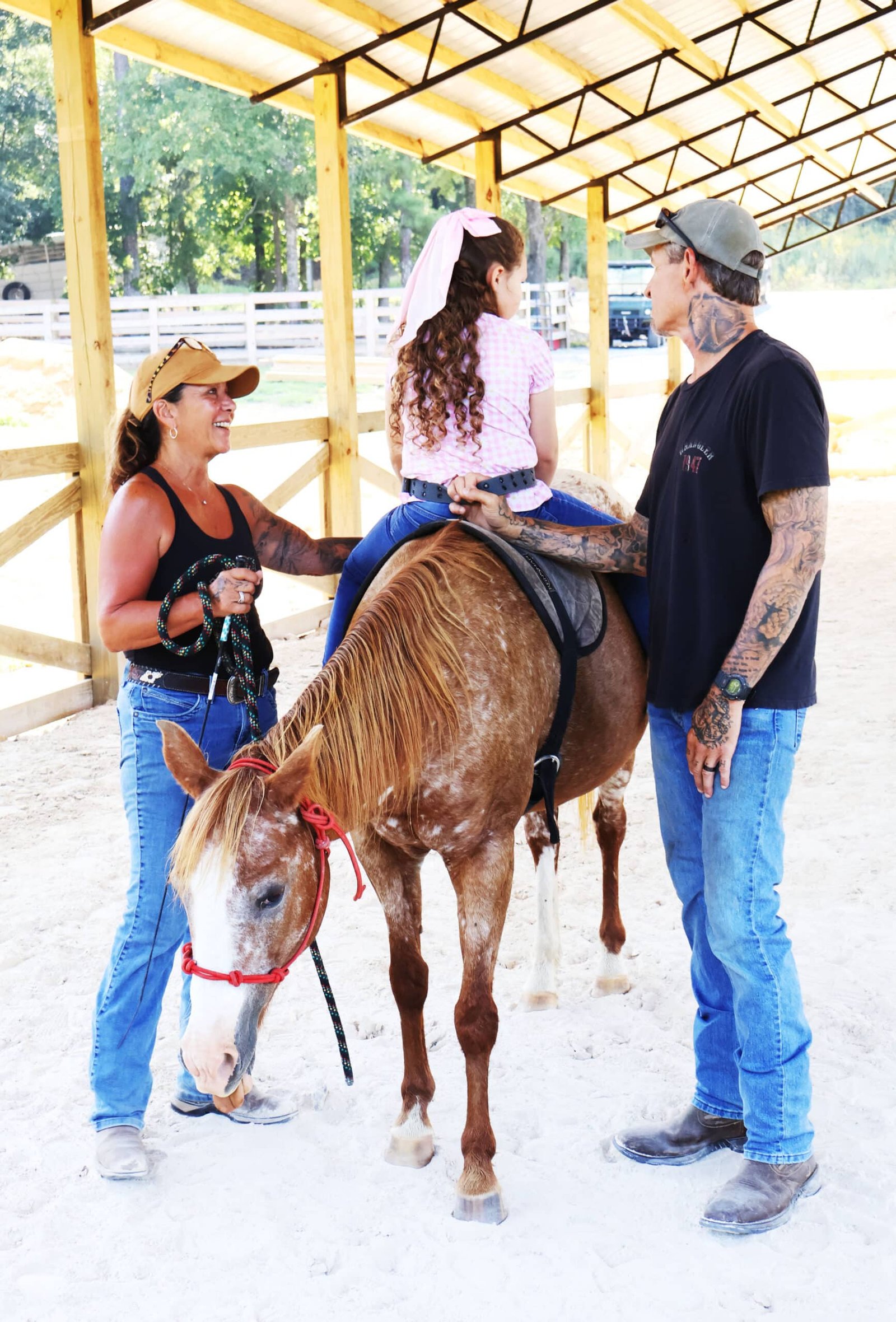
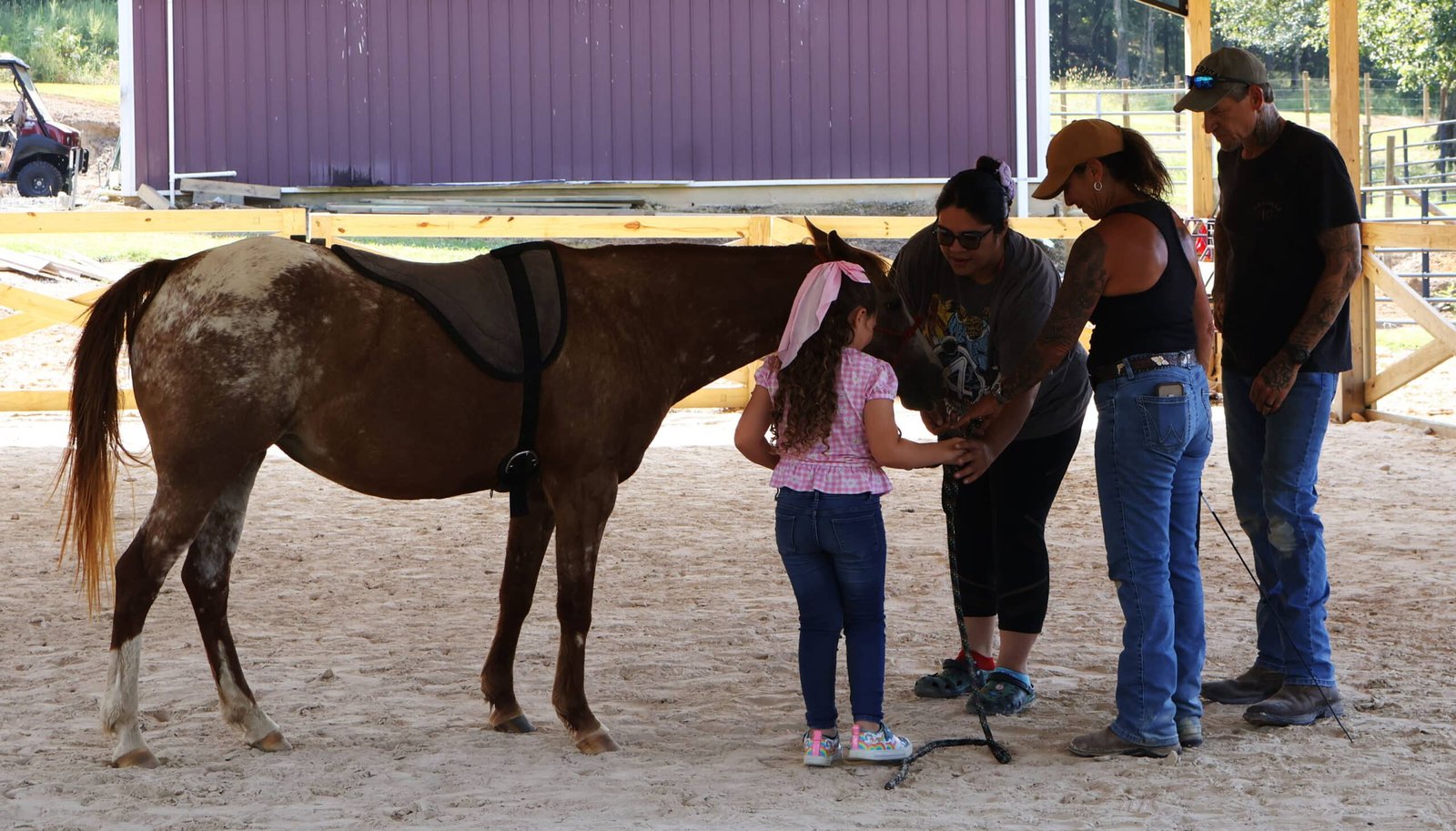
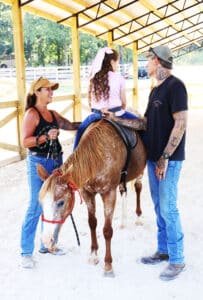
Riding in circles and backwards on Eva, the horse designated for Draper Sensory Therapy sessions with children, Jordy’s excitement was practically bubbling over — and no one knew that better than her own mother, Jazlyn Wills.
“She’s already started talking more, and it’s only the second session,” Wills stated. “She really loves this — the horses.”
After a short session where Jordy engaged with Eva through Draper Sensory Therapy, McCormick helped her off the horse and gave her a treat to feed Eva, who was happy with the reward.
“You can see in Jordy, for instance, that her brain doesn’t stop at all,” McCormick explained after Jordy’s session. “Most kids riding around for 30 minutes will become completely regulated. I get her for intervals; she’ll get up there for a little while, she’ll relax — and then she’s off the rails again. She’s nonstop energy.”
McCormick went on to explain that the fine details — like a horse’s particular shoulder rotation, gait or body language — can play a significant role on the effectiveness of the therapy, and finding the right fit is tricky.
“Next time, I’m going to put her on a big horse that has a different shoulder rotation so that we can get her a little bit more regulated…I typically use Eva for the littles, just because she’s less intimidating and has a different gait — but I’m going to take Jordy to another, bigger Western pleasure horse so that we can see if that’s a better fit for her.”
As tricky as it can be, it is also very rewarding work in that McCormick gets to help other people using her horses — and she knows that she has been blessed.
“Being a single mom, being a domestic violence survivor, being a child who has attempted suicide, being an estranged mom, I didn’t have an easy walk,” she stated, “so I want to provide that to others who also don’t have an easy walk. God gave me this life so I can be here for others, and He blessed me with these amazing creatures to do it with.”
And for Amy McCormick, that blessing is irreplaceable — and she hopes that her work becomes an irreplaceable blessing for the people she has helped in turn.
Readers can contact Amy McCormick through Hope in Her Eyes’s website, hopeinhereyes.org, or by email at [email protected] to book a consultation or inquire about or donate to the nonprofit.