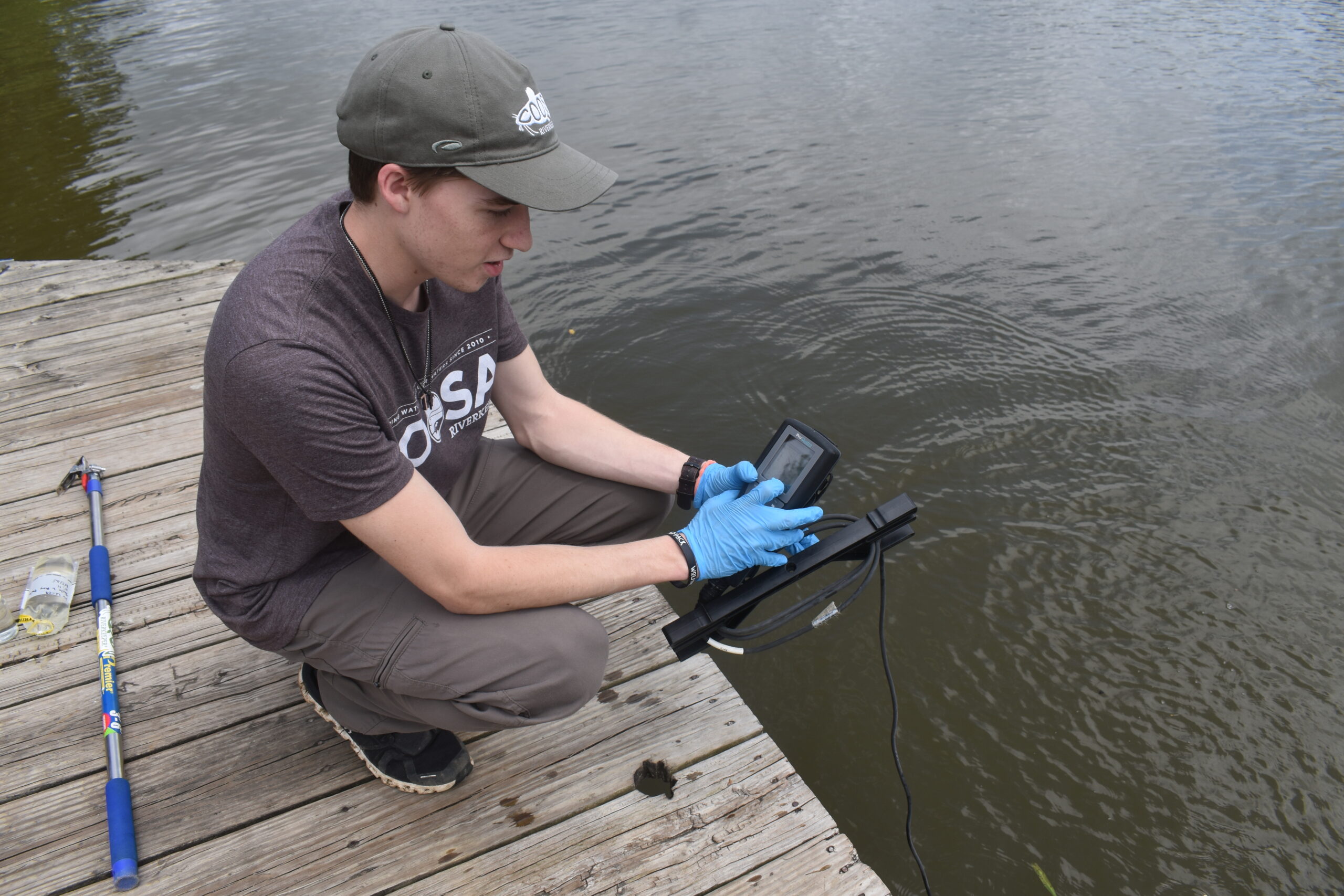
On behalf of Coosa Riverkeeper, the Southern Environmental Law Center (SELC) filed a lawsuit against Alabama Power Company over ongoing groundwater pollution from Alabama Power’s failed closure by capping its leaking toxic coal ash lagoon at the former Gadsden Steam Plant. This ongoing pollution has been a problem since the lagoon was capped in a manner that violates of the Resource Conservation and Recovery Act (RCRA) and the Coal Combustion Residuals (CCR) Rule, which regulate coal ash disposal.
Coal ash is the byproduct of burning coal for energy generation. Alabama Power chose to store nearly 1.5 million tons of toxic coal ash created at Plant Gadsden in an unlined pit, in the floodplain, on the banks of Neely Henry Lake and the Coosa River. Alabama Power “capped” the pond in an unlined leaking pit, but the company’s own reports show the ash underneath remains in contact with water — in fact, nearly 40 percent of the ash remains saturated in water. As recently as October 2024, Alabama Power reported levels of arsenic forty times the legal standard in groundwater in its testing wells. This shows that Alabama Power’s chosen method of burying its toxic coal ash does not protect important groundwater resources. Alabama Power also relies on a faulty groundwater monitoring system that does not adequately measure how the magnitude of coal ash contamination of the environment. These are clear violations of national coal ash disposal standards.
“The citizens of Gadsden and folks who depend on Neely Henry Lake deserve so much better than Alabama Power’s legacy of pollution,” said Justinn Overton, Executive Director and Riverkeeper at Coosa Riverkeeper. “Drinking water supply, booming ecotourism, and hard-working Alabamians are all threatened by Alabama Power’s recklessness. It’s time for Alabama Power to do the right thing and move their ash.”
The coal ash pond is less than a mile upstream from a drinking water intake for the Gadsden Water Works and Sewer Board that provides drinking water to over 14,000 customers.
Neely Henry Lake’s estimated economic impact for the region was up to $570 million in 2017. Catastrophic coal ash spills in Kingston, Tennessee and on the Dan River in North Carolina and Virginia show that health, environmental, and economic impacts of an unthinkable coal ash tragedy take decades to recover from.
“There is no excuse for a company with Alabama Power’s resources to risk a community and commercial riverfront with this type of hazard,” said Barry Brock, director of SELC’s Alabama office. “Alabama Power must join utilities across the South cleaning up unlined coal ash dumps. This type of waste must be in safe storage away from waterways like the Coosa and Neely Henry Lake.”
Coal ash contains dangerous heavy metals like lead, mercury, cadmium and arsenic, which are known to cause cancer and other serious illnesses, according to the EPA.
Utilities across the Southeast have moved more than a quarter of a billion tons of toxic coal ash to safe, dry, lined landfills, or they are recycling ash into cement and concrete. Every unlined pond in North and South Carolina has been excavated or is being excavated, including Duke Energy who is excavating more than 145 million tons. In Virginia, Dominion Energy is excavating all its unlined coal ash impoundments, and Appalachian Power is excavating its sole open coal ash impoundment. The Tennessee Valley Authority is excavating 12 million tons of coal ash. Alabama Power’s sister company, Georgia Power, is excavating half of the coal ash it has stored in unlined ponds, and in May 2024 submitted plans to excavate another 16 million tons.
The Southern Environmental Law Center is one of the nation’s most powerful defenders of the environment, rooted in the South. With a long track record, SELC takes on the toughest environmental challenges in court, in government, and in our communities to protect the region’s air, water, climate, wildlife, lands and people. Nonprofit and nonpartisan, the organization has a staff of 200, including more than 130 legal and policy experts, and is headquartered in Charlottesville, Va., with offices in Asheville, Atlanta, Birmingham, Chapel Hill, Charleston, Nashville, Richmond and Washington, D.C.
Submitted by SELC